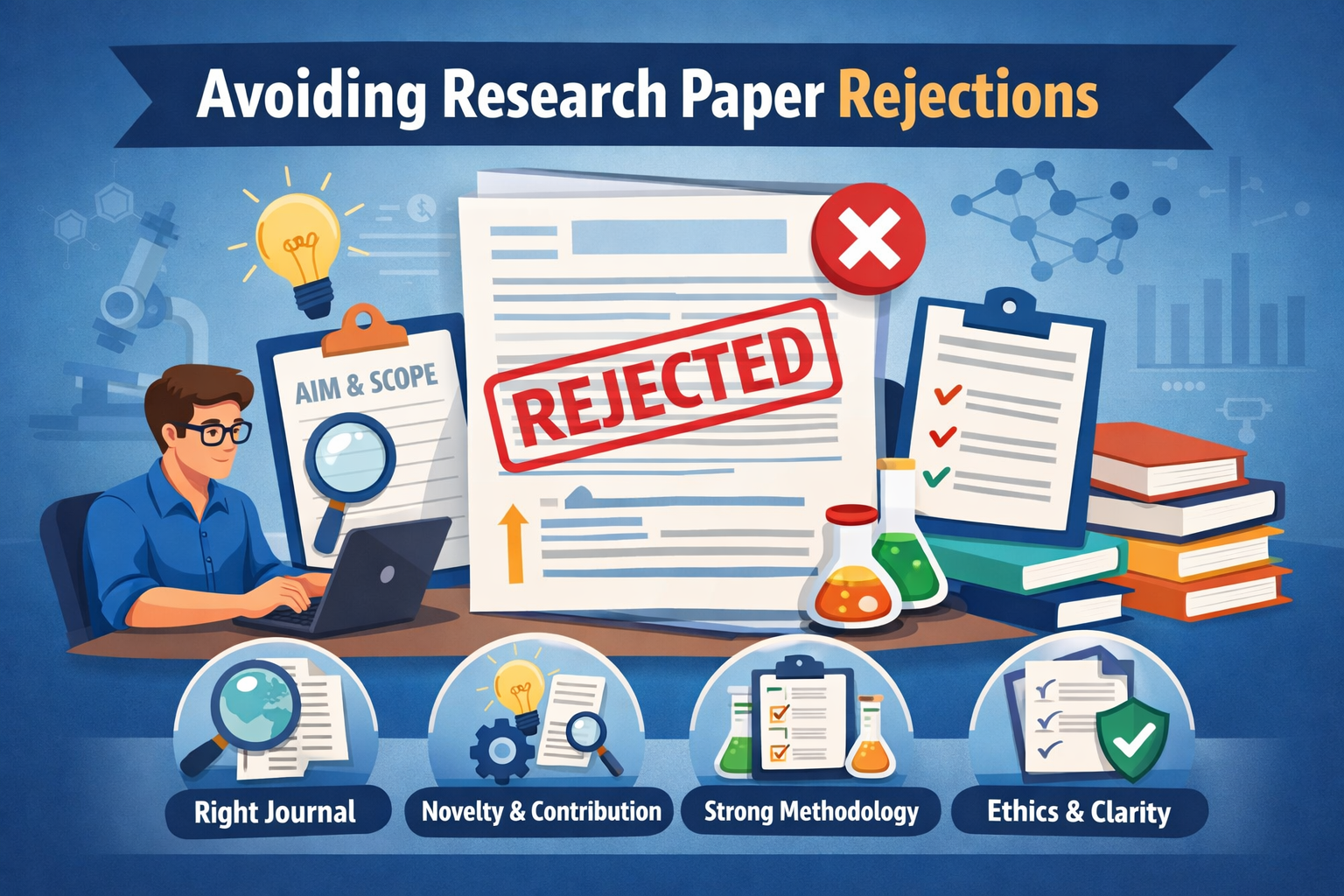
Research paper rejection is a common experience in academia. Even experienced scholars face multiple rejections before publication. However, most rejections are avoidable if researchers understand what journals expect and prepare their manuscripts carefully. This article explains the most common reasons for rejection and provides actionable strategies to improve acceptance chances.
1. Choose the Right Journal
One of the biggest mistakes is submitting a paper to an unsuitable journal.
How to avoid this:
- Match your scope, topic, and methodology with the journal’s aims
- Check recently published articles
- Review indexing (Scopus, SCI, UGC, etc.)
- Understand acceptance rate and review timelines
📌 Tip: Never submit without reading the journal’s “Aims and Scope”.
2. Ensure Novelty and Research Contribution
Journals reject papers that lack originality or clear contribution.
Ask yourself:
- What is new in my work?
- How does it differ from existing studies?
- Does it solve a real research gap?
Clearly highlight novelty in:
- Abstract
- Introduction
- Conclusion
3. Write a Strong Abstract and Introduction
Editors often decide within 2–3 minutes whether to send a paper for review.
A good abstract should include:
- Research problem
- Methodology
- Key findings
- Practical or theoretical contribution
The introduction must clearly define:
- Problem statement
- Research gap
- Objectives and significance
4. Follow Journal Guidelines Strictly
Many papers are rejected without review due to formatting issues.
Common problems:
- Incorrect referencing style
- Exceeding word limits
- Missing ethical statements
- Poor figure and table formatting
📌 Tip: Download the journal’s author template and follow it exactly.
5. Improve Language and Clarity
Poor English and unclear writing weaken good research.
Improve readability by:
- Using simple and concise sentences
- Avoiding unnecessary jargon
- Checking grammar and flow
- Using professional proofreading tools if needed
Editors prefer clarity over complexity.
6. Use Proper Methodology and Data Analysis
Weak methods lead to guaranteed rejection.
Ensure:
- Clear justification of methods
- Proper sampling and data size
- Correct statistical or ML techniques
- Transparent result interpretation
If using AI/ML models:
- Explain model selection
- Include validation techniques
- Report evaluation metrics correctly
7. Cite Relevant and Recent Literature
Outdated or irrelevant references reduce credibility.
Best practices:
- Cite recent (last 5 years) studies
- Include journal-specific citations
- Avoid excessive self-citation
- Use reputed databases (Scopus, Web of Science)
8. Avoid Plagiarism and Ethical Issues
High similarity scores or ethical violations lead to immediate rejection.
Always:
- Keep similarity below acceptable limits
- Paraphrase properly
- Cite all sources
- Declare conflicts of interest
- Mention ethical approval where required
9. Respond Carefully to Reviewers
Rejection after revision often happens due to poor responses.
While revising:
- Address each comment point-by-point
- Be polite and professional
- Provide justification where you disagree
- Highlight changes clearly
📌 Tip: Never argue emotionally with reviewers.
10. Learn from Rejection
Rejection is not failure—it is feedback.
After rejection:
- Read editor and reviewer comments carefully
- Revise the paper
- Improve weak sections
- Submit to a better-suited journal
Many published papers were rejected multiple times before acceptance.
Final Thoughts
Avoiding research paper rejection requires:
- Strategic journal selection
- Strong writing
- Clear novelty
- Methodological rigor
- Strict guideline adherence
Rejection is part of the academic journey, but smart preparation can significantly reduce it.
Leave a Reply